Watercolor Fish Seamless Digital Paper: A Comprehensive Guide for Creative Professionals
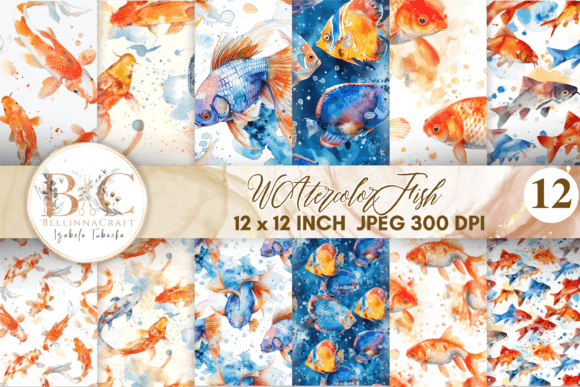
In the rapidly evolving landscape of digital design, finding assets that balance artistic authenticity with technical precision is a constant challenge. Among the various textures and patterns available to designers, Watercolor Fish Seamless Digital Paper has emerged as a distinct category that bridges the gap between traditional hand-painted aesthetics and modern vector-based workflows. This specific collection, featuring 12 unique Koi fish patterns, offers more than just a decorative background; it provides a versatile foundation for projects ranging from high-end stationery to complex web interfaces.
When evaluating resources for creative work, the distinction between a generic stock image and a purpose-built seamless pattern becomes critical. The Watercolor Fish Seamless Digital Paper set is designed specifically for scalability and repetition without visible seams, making it ideal for large-format applications where continuity is paramount. Unlike standard illustrations that are often fixed in size or require tedious tiling, this format allows creators to apply the texture across an entire surface while maintaining the organic flow of watercolor brushstrokes and the fluid movement of koi fish.
Distinguishing Features of the Collection
The primary differentiator of this specific digital paper pack lies in its composition and resolution. Each of the 12 designs is created as a unique asset, ensuring that no two patterns are identical. This uniqueness is vital for designers who need to avoid the repetitive look common in mass-produced clip art. The inclusion of Koi fish patterns adds a layer of cultural and aesthetic depth, as these motifs often symbolize perseverance and good fortune, adding narrative value to the visual design.
From a technical standpoint, the specifications are tailored for professional output. The files are provided in a 12×12 inch format at a resolution of 300 DPI. This high resolution ensures that when the images are printed, they retain crisp edges and smooth color gradients, which is essential for print-on-demand services, photography backdrops, and physical merchandise. The JPG format, while universally compatible, is paired here with a seamless repeat structure, meaning the edges align perfectly when tiled. This eliminates the need for manual cropping or masking to hide grid lines, a common frustration when working with lower-quality digital papers.
Comparing Digital Papers to Alternative Design Assets
To make an informed decision, it is helpful to understand how Watercolor Fish Seamless Digital Paper compares to other common design elements. One frequent alternative is using vector graphics (SVG or AI) for similar themes. While vectors offer infinite scalability without pixelation, they often lack the textural nuance of watercolor. A vector koi might appear too clean or rigid for a project requiring a soft, organic feel. In contrast, the digital paper retains the irregularities of paint on paper, offering a tactile quality that vectors struggle to replicate authentically.
Another comparison point is standard raster photography. Photographers might capture real fish or painted canvases, but these images rarely come pre-formatted as seamless repeats. Using a photograph requires significant post-processing to create a repeating pattern, often resulting in visible artifacts or "ghosting" where the image does not align. The Watercolor Fish Seamless Digital Paper arrives ready-to-use, saving hours of editing time. However, unlike a raw photograph, you cannot easily isolate individual elements within the pattern without using masking tools, as the fish and background are integrated into a single flat file.
Furthermore, compared to solid color backgrounds or simple gradients, these papers add immediate visual interest and context. They serve as a complete environment rather than a blank slate. For a designer building a wedding invitation suite, choosing a subtle watercolor fish pattern can set a thematic tone immediately, whereas a solid color would require additional graphic elements to convey the same aquatic or nature-inspired mood.
Strengths and Limitations in Application
The strengths of this resource are most evident in projects requiring high-volume printing or consistent branding. Because the pattern is seamless, it can be used for wrapping paper, fabric design, or wall coverings without interruption. The 300 DPI resolution supports commercial-grade printing, ensuring that the delicate washes of watercolor do not pixelate when enlarged. Additionally, the variety within the set—12 different variations—allows for cohesive yet diverse collections. A planner designer, for instance, could use one pattern for the monthly covers and another for the interior dividers, creating a unified brand identity.
However, there are tradeoffs to consider. The fixed 12×12 inch size, while convenient for many tasks, may require resizing for very large formats like billboards or massive murals. While scaling up a 300 DPI image is generally safe, extreme enlargement can eventually lead to softness. Furthermore, because the files are JPGs, they do not support transparency layers. If a designer needs to place the fish pattern behind a transparent object or cut out specific fish shapes, they must rely on external editing software to mask the background, which adds a step to the workflow. This is a limitation compared to layered PSD files or SVG formats.
Ideal Use Cases and Project Scenarios
Identifying the right project for these digital papers is key to maximizing their value. They are particularly well-suited for stationery and invitations. The soft, artistic nature of watercolor complements the elegance required for weddings, baby showers, and formal events. The Koi motif adds a touch of sophistication without being overly literal, making it appropriate for both casual and formal occasions.
Scrapbooking and digital journaling represent another strong fit. Hobbyists and professionals alike benefit from the ability to create custom layouts quickly. The seamless nature allows users to fill entire pages with a background that feels hand-crafted but is easy to apply. Similarly, for web backgrounds and UI design, these papers provide a textured backdrop that reduces eye strain compared to stark white screens, while still maintaining readability for text overlays.
In the realm of home decor and promotional materials, the versatility shines. These patterns can be applied to phone cases, tote bags, and packaging. The high resolution ensures that the logo or product placed over the pattern remains legible, as the watercolor tones are generally muted enough not to clash with bold typography. For planners and organizers, the variety of 12 designs offers ample choice for different sections or seasons, allowing for a personalized organizational system.
Decision Factors: When to Choose This Resource
Choosing Watercolor Fish Seamless Digital Paper over other options should depend on the specific needs of the project's lifecycle. If the goal is rapid production of physical goods with a consistent aesthetic, this format is superior to sourcing individual illustrations. The time saved on creating seamless repeats translates directly to cost savings and faster turnaround times.
Conversely, if the project requires heavy manipulation of individual elements—such as animating the fish swimming or isolating them for a complex composite image—a vector source or a layered Photoshop file might be more appropriate. The seamless JPG format is best for static applications where the pattern acts as a texture or background rather than a collection of movable objects.
Additionally, the decision often hinges on the desired artistic style. For projects aiming for a modern, geometric, or corporate look, these organic watercolor patterns may feel too informal. However, for brands targeting audiences interested in wellness, nature, arts, or lifestyle, the hand-painted aesthetic resonates deeply. It conveys a sense of human effort and care that automated design tools often fail to produce.
Evaluating Value and Longevity
When assessing the long-term utility of any digital asset, the question of exclusivity arises. Since every design in this pack is unique and not found elsewhere, it reduces the risk of your project looking generic. In a market saturated with template-based designs, having access to exclusive patterns helps differentiate a brand or a personal portfolio. The durability of the files is also a factor; JPGs are widely supported by almost all design software, from Adobe Creative Cloud to free online editors, ensuring that the investment remains accessible regardless of future software changes.
Ultimately, the Watercolor Fish Seamless Digital Paper serves as a foundational tool for creatives who value efficiency without sacrificing artistic integrity. It solves the technical problem of seamless tiling while providing a rich, culturally resonant visual theme. Whether used for a small-scale craft project or a large-scale commercial print run, the combination of high resolution, unique design, and practical formatting makes it a robust choice for a wide array of applications.
For those navigating the vast sea of digital resources, understanding the specific capabilities and limitations of such assets is essential. By recognizing the balance between the organic beauty of watercolor and the technical demands of digital reproduction, designers can select the right tools to bring their visions to life effectively.